Testing
- Oct 7 2010 - lowering impedance of TDD with python mock ...
So after my post about gaeunit a few weeks ago I’ve since completely thrown out what I was doing there and moved to vanilla python unit tests. I ended up making this move for a few reasons.
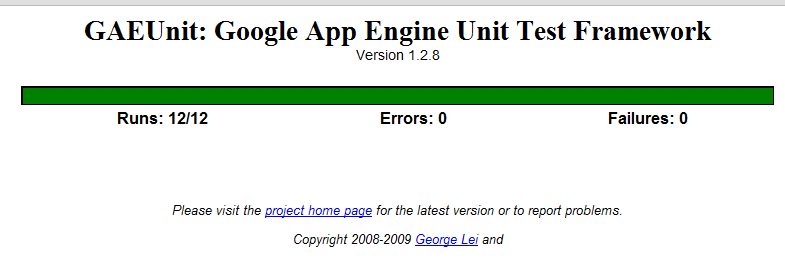
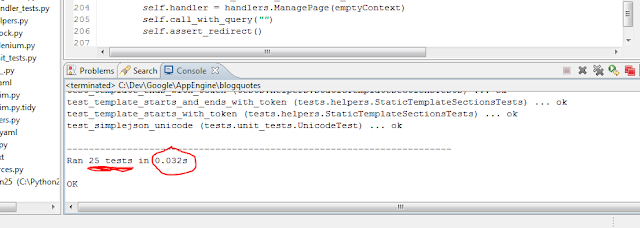
1. I was never running my tests.- GAEUnit was nice, but slow. Even when running tests in parallel I still had to go through the process of opening the browser, navigating to the right place and letting the tests run. Compare this to ctrl-f9 and seeing the following:
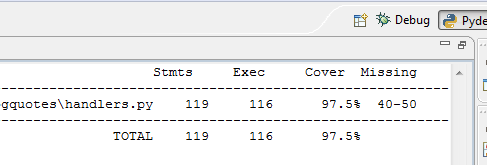
 2. AND I love seeing code coverage numbers and while it might actually be possible with GAEUnit, it wasn’t this easy…
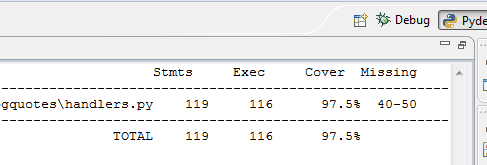 In the end it was relatively simple once I started employing mocking to deal with sessions and realized that I could actually issue real request objects to my handlers with relative ease…webObReq = Request.blank(url)webApReq = webapp.Request(webObReq.environ)handler.initialize(webApReq, webapp.Response())For the mocking I eventually decided to go with this framework:It has so far been fine for my needs and at least my handlers have almost achieved 100% coverage. The syntax is a little foreign compared to Moq, but hasn’t been a blocker to me actually getting work done so I’d recommend it.
 - Aug 20 2010 - Unicode woes and Python unit testing in GAE ...
One of the really cool aspects of deploying to Google’s cloud offering (GAE) versus the more machine oriented Microsoft Azure and Amazon EC2 approaches are that you really are only dealing with computing resources. You deploy your app not to any particular server, but to the cloud itself. Despite the very real challenges in distributing work across data centers I am still filled with visions of automagical propagation and distribution and unlimited elastic computing. Beautiful. Anyway I was inspecting the logs and was SHOCKED to discover that there have been close to a thousand quotes added to system by 37 users. THIRTY SEVEN USERS!! Now, these are small numbers I know, but given the only publicity I’ve ever given this has been the two posts on this blog I was absolutely amazed to find that people had not only managed to find the app but were able to use it! (It’s quite ugly)
There is nothing quite as motivating as having users.
So I started looking at log files and discovered that I am actually throwing errors for at least some of those users who are not English speaking and are using Unicode characters. Oops. You’d think I’d know better by now. See : The Absolute Minimum Every Software Developer Absolutely, Positively Must Know About Unicode and Character Sets (No Excuses!)
In most cases for these bugs it just meant calls to unicode(var) rather than str(var) . So for example when parsing url variables starting with the example provided here by Google and adding my own processing of an array of arguments to a method like so…
def update_field(self, fieldName, *args):
strings = [str(arg) for arg in args]
….
return
and then calling that code with a unicode character such as ‘’–" would produce an error that looked like this…UnicodeEncodeError: ‘ascii’ codec can’t encode character u’\u2013’ in position 0: ordinal not in range(128)
the same code as above corrected is below. There were a few variants on this but this is a good example of a function where user defined input dictated a change to accommodate.def update_field(self, fieldName, *args):strings = [unicode(arg) for arg in args]….return
So in the course of digging in and finding/fixing these bugs I also recognized I was far overdue for some unit testing. So starting with the premise that I needed a way to reproduce the issue in the lab and write a failing test for this bug I went in search of the best method to do so. Python actually has [pretty good unit test support] built-in but I was also looking for something that would work in the context of GAE. It doesn’t take much looking before stumbling on GAEUnit, which is a useful extension that provides some scaffolding for tests that will run within GAE. The major negative to this is that your tests are part of your application, but I don’t have a problem with that as it’s easy to secure them to administrator access only but for some people it’s a block.
The next issue I ran into with this was the fact that the python SDK for GAE doesn’t include a method for testing content behind authentication. So whereas in Java you can say this :private final LocalServiceTestHelper helper =
new LocalServiceTestHelper(new LocalUserServiceTestConfig())
.setEnvIsAdmin(true).setEnvIsLoggedIn(true);public void testIsAdmin() {
UserService userService = UserServiceFactory.getUserService();
assertTrue(userService.isUserAdmin());
}
But today there is no equivalent for that in python. I wasted a few hours trying to work around this issue before deciding to just login before I run tests. My login lasts for hours so this isn’t much of a constraint. In the long run I plan to drop Google’s authentication any and move to janrain/rpx to allow users to login using whatever they like. That will mean abandoning or at least shimming the infrastructure provided by GAE, but has the additional benefit of reducing my applications direct dependency on Google. Once I have my own definition of Session and session provider I can of course mock it out and control it a lot easier.
Here’s the test, no asserts but if there is a problem we’ll see an exception
def test_unicode_to_json_error(self):
badQuote = q.Quote(quote=‘hi there ’ + u"\u2013")
result = badQuote.jsonSafe()
simplejson.dumps(result)
So one error-type in the log file later I’ve spent a couple days, done a bunch of refactoring and have produced no new functionality… but I do have this!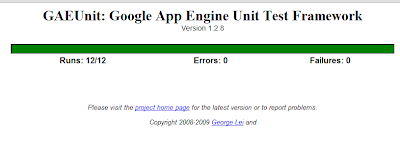
Of course then, after all that I STILL ran into an error with the JavaScript, for which I have yet to add unit testing for. Sigh. I’ll have to choose between qUnit which I’ve used before and YUI-test which is probably better aligned to the rest of my application.
The JavaScript portion of this bug was basically because I was calling unescape() on a url-encoded variable. URL encoding though only supports 8-bit characters and doesn’t truly allow unicode, so my unicode characters became three ascii characters which could include control characters or other undesired results. There seems to be a lot of people standardizing on UTF-8 within url-encoded variables but it’s purely a convention at this point. Thankfully I found this pre-written code on webtoolkit.info that knows how to do the look ahead at the next three characters in order to handle UTF-8 input properly.
Now I hope it’s safe to say that blogquotes can handle unicode! (and has some unit tests to boot!) - Apr 30 2009 - From test spy to Verify() with Moq ...
Moq is now my favorite unit testing framework for .NET, and a great poster child for the power of the lambda expression support added to C#. If you are not doing unit tests or Test Driven Development you should, and if you already are and have not checked out Moq, you should.
My tests previous to Moq were using NMock, a very handy tool that looks like a lot of other mock frameworks. In order to setup a mock call you would write something similar to this :
[Simple NMock example]Mockery mocks = new Mockery();
IWidgetAdapter mockAdapter = mocks.NewMock();
IListmockWidgets = new List ();
Widget mockWidget = new Widget();
mockWidget.Name = “Mock Widget”;
mockWidgets.Add(mockWidget);
Stub.On(mockAdapter).Method(“LoadWidgets”).WithNoArguments().Will(Return.Value(mockWidgets));
WidgetManager widgetManager = new WidgetManager(mockAdapter);
The ugliest thing in the expression above for me was the literal string that describes the method name that will be called. All of a sudden my fancy refactoring tools don’t quite reach all of my code and things become brittle. Sure you say, but I run these tests all the time! So it is caught right away anyway right? Yeah, but who wants to be searching and replacing these values after every refactor? Just does not feel right.
Here’s the Moq equivelent:
[simple Moq Example]IList
mockWidgets = new List ();
Widget mockWidget = new Widget();
mockWidget.Name = “Mock Widget”;
mockWidgets.Add(mockWidget);
MockmockAdapter = new Mock ();
mockAdapter.Setup(cmd => cmd.LoadWidgets(It.IsAny())).Returns(mockWidgets);
WidgetManager widgetManager = new WidgetManager(mockAdapter.Object);
See that the “LoadWidgets” string disappears, and refactoring code now properly refactors tests right along with it, very very handy. Some find the need to add .Object when referencing the underlying mocked type annoying (on the call to WidgetManager) but personally I find this a small price to pay.
When I first started using Moq a few weeks ago I didn’t go much beyond that example. Which speaks to Moq in that it is VERY easy to get started without much effort and more advanced features really don’t get in the way of the simple features.
For a while I was able to do a lot of the testing I had in place by Asserting on values I either had access to or were being returned to me. In those cases where the values I needed were being returned to someone else (say a Service for example) I was in the habit of building stub classes (Test Spy in this case) to handle the outgoing data.
So using the generic service as an example, and wanting to observe and Assert that I am sending the correct requests to that service my previous code would have looked something like this:
[Test spy example]public class AuthenticationSpy : IAuthenticationService
{
#region Test Helpers
public IListReceivedReqeustContexts = new List ();
public AuthenticationResponse ExpectedResponse { get; set; }
#endregion
public AuthenticationResponse AuthenticateUser(AuthenticationRequest request)
{
return ExpectedResponse;
}
public AuthenticationResponse RenewAuthenticationTicket(RequestContext context)
{
this.ReceivedReqeustContexts.Add(context);
return ExpectedResponse;
}
}
[TestMethod]
public void RenewExpiredTicketTest()
{
AuthenticationSpy _authenticationMock = new AuthenticationSpy();
Mock_respondingMock = new Mock ();
MockmockServices = new Mock ();
mockServices.Setup(cmd => cmd.GetAuthenticationService(It.IsAny())).Returns(_authenticationMock);
mockServices.Setup(cmd => cmd.GetRespondingService(It.IsAny())).Returns(_respondingMock.Object);
ServiceWrapper.Current.ServiceProvider = mockServices.Object;
_authenticationMock.ExpectedResponse = GetGoodAuthenticationResponse(DateTime.UtcNow.Add(ServiceWrapper.Current.TimerSleepTimeSpan.Subtract(TimeSpan.FromMinutes(1))));
// initialize will call authenticate() in the service wrapper
ServiceWrapper.Current.Initialize(“testing”, “Password1”, “http://auth”, “http://resp”);
// now setup and call any method to trigger a renew of our now expired authentication ticket
SetupCreateResponse(Guid.NewGuid());
SurveyController.StartSurvey(new StartSurveyArgs());
// confirm renew was actually called
Assert.IsTrue(_authenticationMock.ReceivedReqeustContexts.Count == 1);
}
This works, and in some cases the control given to you with your test spy can be really helpful, but if I can avoid it I will every time. More classes and more code means more maintenance, even if it is in the test code. So I finally read the docs on the Verify() method on Moq objects and it is awesome. ;-) Here’s the same code handled with Moq properly and without the need for a whole new class imitating the authentication service.
[using Verify example][TestMethod]
public void RenewExpiredTicketTest()
{
Mock_authenticationMock = new Mock ();
Mock_respondingMock = new Mock ();
MockmockServices = new Mock ();
mockServices.Setup(cmd => cmd.GetAuthenticationService(It.IsAny())).Returns(_authenticationMock.Object);
mockServices.Setup(cmd => cmd.GetRespondingService(It.IsAny())).Returns(_respondingMock.Object);
ServiceWrapper.Current.ServiceProvider = mockServices.Object;
_authenticationMock.Setup(cmd => cmd.AuthenticateUser(It.IsAny()))
.Returns(GetGoodAuthenticationResponse(DateTime.UtcNow.Add(ServiceWrapper.Current.TimerSleepTimeSpan.Subtract(TimeSpan.FromMinutes(1)))));
// initialize will call authenticate() in the service wrapper
ServiceWrapper.Current.Initialize(“testing”, “Password1”, “http://auth”, “http://resp”);
// now setup and call any method to trigger a renew of our now expired authentication ticket
SetupCreateResponse(Guid.NewGuid());
SurveyController.StartSurvey(new StartSurveyArgs());
// confirm renew was actually called
_authenticationMock.Verify(cmd => cmd.RenewAuthenticationTicket(It.IsAny()), Times.AtLeastOnce());
}
Check out Part 2 in the 4 part series “Beginning Mocking with Moq 3 ” gives a short description of how Validate works.
Not bad eh? Again the power of the lambda expression here jumps out at you. Full intellisense and compiler support for describing exactly what you expect that method to receive. The “It” class allows for no description “It.IsAny<t>()” or very precise description as above. The “Times” check also allows you to narrow Significant savings in code and maintenance and actually using the testing framework as intended (imagine that) ! My only slight annoyance so far is in having to keep count of the number of times a method has been called in order to check that the last piece of code actually resulted in a call and not some code way earlier. - Jul 20 2008 - Networks, Assignment 1 ...
I just finished my first assignment in a beginning networking course I’m taking and I am so far pretty impressed with how interesting this stuff is. I have a working knowledge of networking that includes decent understanding of the application layer, high level knowledge of the transport layer and basically just awareness of the link layer. It’s pretty rare that in my position as a developer that I need to answer questions about the link layer. (thank you my friends in IT)
The football field question actually relates to a pretty interesting concept called bandwidth-delay, which refers to the amount of data that exists “on the wire” or “on the air” at any given moment. Data that has been sent but not yet acknowledged. It’s helpful in determining minimum buffer sizes for receivers and transmitters over a given link.
Some of the questions are actually kind of fun in that they had me visualizing data flowing through networks in ways I had not before. For example given a link between two hosts X km apart, with a transmission rate of R and a propagation delay of N….
2.4.d What is the width (in meters) of a bit in the link? Is it longer than a football field?
Kind of useless, but super fascinating at the same time, imagining the physical manifestation of all this work I do day in and day out. Pulling these bits from all over the world is so effortless, so fast and so transparent that it’s easy to forget the actual resources behind it.
http://en.wikipedia.org/wiki/Bandwidth-delay_product
Another element to this first assignment was to setup apache as a proxy server on your local machine which was a bit surprising. I assumed at first that the assignment meant squid, but no, apparently apache itself can be configured to be a proxy server for a number of protocols including both ftp and http traffic.There are numerous articles out there on using it as a personal ad blocker, or caching server.
For reference this is what I had to do to Httpd.conf to make it work :LoadModule disk_cache_module modules/mod_disk_cache.so
Interestingly if you get that configuration wrong, you actually get a big “It Works!” page shown in your browser for any page you try to visit. Go figure. My mistake at that point was just not having uncommented the right modules, so apache was just serving the It Works page rather than attempting to proxy my request.
LoadModule proxy_module modules/mod_proxy.so
LoadModule proxy_http_module modules/mod_proxy_http.so
LoadModule proxy_connect_module modules/mod_proxy_connect.so
<IfModule mod_proxy.c>
ProxyRequests On
<Proxy *>
Order deny,allow
Deny from all
Allow from 10.0.1.2/255.255.255.0
</Proxy>
</IfModule>
<IfModule mod_disk_cache.c>
CacheRoot “c:\apachecache"
CacheDirLevels 5
CacheDirLength 3
</IfModule>