Reading
- May 6 2009 - Transcendent Man! ...
I read the singularity is near last year and really enjoyed it, despite a few misgivings for Kurzweil’s ego and some dubious use of statistics. One of the things I found myself really intrigued by was Kurweil himself and this movie looks like a fun look at the man and his ideas.
Do I believe him? Part of me wants to, definitely. The ultimate end-game of the singularity is fascinating and wondrous, but I actually found some of the more intermediate steps in his projections to be more fascinating. Maybe that’s just a factor of what I can relate to. One example of this was the idea that nano-technology will lead us to self-assembling products from base materials and an instruction set transmitted as information. So much of my life is already so information focused that the idea of being able to go 100% information based and the implications on how society is structured etc… it’s mind numbingly cool. Try to imagine how much energy, time and effort we put into moving goods around this planet and how incredible it would be for all of that to end.
Anyway, looking forward to renting this one when it becomes available. - May 31 2008 - Vampires in Space ...
I read a very fun book on my holiday in Manitoba this last few weeks. It’s written by a biologist who has turned to fiction with an eye to producing some good hard core science based fiction. I would compare his work to William Gibson and Arthur C. Clarke.
The book is called “BlindSight” by Peter Watts, and I’ve added it to my LibraryThing, there is a link to my full review below.
http://www.librarything.com/work/1333265/reviews/31302401
As an added bonus (I discovered this after buying the book) the author has published it under a creative commons license and you can read the entire book online for free. How cool is that? (Read it here)
There is a lot to chew on in this book, but my post subject says it all. Seriously though, don’t judge based on that, it’s a good book. No really…
No
Yes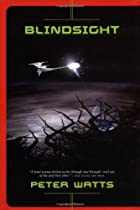
- May 7 2008 - poetic words = exciters of nearby symbols ...
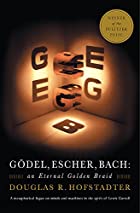
In GEB Hofstadter mentions the complexity in building an isomorphism between two poems written in two languages.“In ordinary language, the task of translation is more straightforward, since to each word or phrase in the original language, there can usually be found a corresponding word or phrase in the new language. By contrast, in a poem of this type, [Jabberwocky, Lewis Carroll] many “words” do not carry ordinary meaning, but act purely as exciters of nearby symbols. However what is nearby in one language may be remote in another."Reading that acted as an exciter for my own interest in poetry. I immediately think about some of the poetry I have read which had the most impact for me and it did exactly this. The ability of a good poet to draw scenes by exciting patterns of shared experience and perception is really amazing. Choosing those “words that excite nearby symbols” is a bit of a game and for me what makes trying to write poetry enjoyable. It becomes almost technical or like solving a problem.I am often cynical that poetry can be really widely appealing if only because the most poignant and effective poems I’ve read require a familiarity with the writer and a shared experience that allows compact transfer of imagery. Then again, some of the power in the compression and lossy nature of these poetic images is that there is room for interpretation in the eye of the beholder.In a field at dusk, trees made short by distance, a line of black on blacker at a horizon pulled ever closer by night… - May 5 2008 - I've forgotten how much I enjoy Unix ...
I just finished reading “The Dream Machine” and getting a very cool look at some early history of computing including the birth of Multics and it’s spin off and almost more interesting the birth of tools like email and ftp as a way to actually do something with the ARPANET that was being built. A great read for anyone interested in how we collectively have arrived at where we are today in computing. And as it happens, I’m also currently challenging a course on Unix which as part of the challenge requires that I complete a project before I can write the final exam.
The project itself is great fun actually. I’ve been in the world of Microsoft for so long at work that I’ve completely forgotten about the old days of living in vi on Solaris as part of my 9-5 work. (CATI programming back then) More than anything about Unix I love the power and flexibility of combining these small well written tools like awk, sed, grep etc. These are incredible tools and it’s easy to forget how powerful a fully text driven system really is.I remember being completely stoked about Microsoft’s powershell project a few years ago. On the surface it seemed to take everything exciting about a Unix environment and add a layer of object orientation across it so that not only could you fully embracing piping and redirection with the help of some impressive shell programming capabilities but you also had the full .net framework at your fingertips and the ability to use reflection to “discover” a system at run time. This discover-ability aspect is key, and the importance of “man” to rusty or newbie Unix users can let you appreciate the value in being able to query objects to ask what they can do. The simplest example of where powershell is so powerful is to just imagine good ole ls, but where each element output from ls was an actual file or directory object. If you do nothing then those are simply iterated by ls and essentially .FileName.ToString() gets called for each… but if you pipe that output to your own iterator you can all of a sudden do some really amazing things with very little effort.Having said that though I never truly fell into powershell like I have unix in the past. In my opinion it’s about the eco-system. The set of utilities in unix work because everything in unix plain old text, meaning the same tools can be strung together to do any countless numbers of tasks without additional support. Compare this to powershell which really loses it’s value where .NET doesn’t exist. True, there are some amazing providers that bridge gaps into SQL Server, WMI, etc etc. But just the fact that you are now talking about .NET development to create those new bridges means we’re half a step behind the accessibility and simplicity of a text file. I do think that powershell will only get better with age, but for now unix as a whole is still king for me even if powershell is sexier.Anyway, this project I’m working on is just a series of clever questions that force you to construct chains of tools to elegantly (or inelegantly) solve a problem. It’s extremely fun and in the course of a couple weeks I’ve reinstalled cygwin at work, gotten ssh access to my mac at home and have had terminal open for pretty much a week straight on my iMac. It’s hard to keep this up without an actual task - and considering I’m still doing 95% .NET development i don’t expect this will continue for too long but it’s a good reminder. - Mar 27 2008 - I have some reading to do! ...
http://listverse.com/literature/top-15-science-fiction-book-series
I came across this list of the best 15 science fiction series ever written. The reason I love seeing this is 1) it contains a bunch of science fiction series I’ve already read and thought very highly of and 2) contains some series I’ve never even heard of, which of course is exciting since it means I have some reading to do.
For all I know the guy who wrote the list is totally unqualified and preying on people’s ego by throwing familiar items on a list with a bunch of obscure ones, but I’m gonna go with it.
The series I’ve read so far :- Space Odyssey
- I’ve only read 2001 so far, and only just recently. I had a total Aha! moment reading that book and finally getting bits of the movie that were totally nonsensical to me at the time. The book was great, the movie is overrated.
- Rama series
- My introduction to Arthur C. Clarke (RIP) and definitely my favorite work of his so far. I loved the matter of fact nature with which Clarke wrote, it helped make everything so believable. That and his respect for actual real science which is a total joy to read.
- Hitch hikers guide to the galaxy
- Douglas Adams is my hero. He is insanely brilliant in the same way George Bush aren’t.
- Ender’s Game
- Honestly I’ve lost track of all the Ender books, so I may not have read all of them, but I’ve read three or four and loved them all. For straight pure entertainment value I don’t know that I’ve ever enjoyed a sci-fi book as much as the original Ender’s game. I recently got Caitlin to read it and she loved it (she’s not exactly a hard core sci-fi fan)
- Foundation Series
- I got through all of these and I think all of the robot books as well. Very quick fun reads that had really nice tie in across books. I’m not sure these deserve the top ranking unless we’re just talking pure volume. They were enjoyable but not life changing enjoyable like Douglas Adams or Arthur C Clarke though.

