- Dec 14 2009 - google chrome software updates make everything else feel broken ... I am growing more and more annoyed at the Apple's and the Adobe's of the world who are constantly interrupting my work to tell me that there are updates waiting for me to install. Why do I have to manage this? Yes I know that I can go in there and tweak the settings so that I don't get annoyed... but why should I even have to do that? I would need to do that across every user account on every machine I use on a regular basis! (5) This is noise, and it isn't at all necessary for me to have to think about it.
I believe this is part of the convenience of applications delivered in the cloud. (sorry to throw that term out there) It is part of the convenience that has me accepting fewer features in order to get that functionality.
There are companies out there who understand this, and are working hard to create a better user experience. Google for example went to great lengths in order to be able to update their entire browser in under 100 KB of download just to make the experience more efficient, user friendly and safer. Not only that but chrome updates happen automatically, again to help with security. It's very close to the experience I get by logging into gmail, which is always up to date. Now I can already hear rattles of complaint about "control" over your own machine, but I have to ignore this or I'll get completely derailed. I'll say in short that I think that control is an illusion, and the alternatives are worse.
If you have not already read this post by the chrome developers I highly recommend it.
http://blog.chromium.org/2009/07/smaller-is-faster-and-safer-too.html
And then you have the Apple, who has gone from a position of pushing hard to avoid needing to reset the operating system unless absolutely needed to requiring reboots for Quicktime, Safari and sometimes even iTunes (especially in windows). You can argue all you want that it's because of kernel extensions or who knows what else - but at the end of the day it doesn't matter why. This is bad design and leads to a diminished user experience.It seems like more and more often I am prompted with a software update dialog that looks like this one. Three out of four of the updates require a reboot! Are you serious? And chances are good that I will continue to ignore this dialog because closing all of my browser sessions, and ending the long running handbrake encode, and stopping the download I have going, and turning off the TV program I'm watching all amount to a whole lot of trouble for something I don't think I should even have to think about.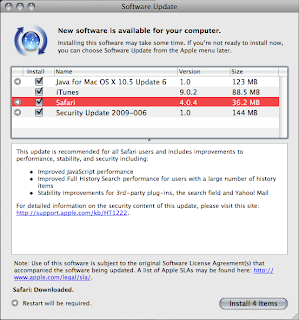
Seriously what is so special about Safari that they require me to download 36.2 MB and restart my machine for a point release?? Maybe this didn't seem so offensive before Chrome, but now it feels dated and clunky.
I really should pick on Adobe here for the horror that is the Adobe Updater, but honestly I really do expect more from Apple. Adobe is too easy of a target.
Please fix this Apple, you can do better. Where is the Steve Jobs who wanted to save lives by reducing boot times?? - Nov 9 2008 - What you are reading is consuming energy ... Consumption is one of those things that is on my mind a lot. Both economically as I aim to live debt free and with as little "stuff" as really needed as well as in other forms of energy. Buy local, buy less packaging, drive less, eat less! It goes on and on.
One of the really interesting things with looking at google appengine is their metering and logging of your application. The GAE has limits on how much disk, cpu and bandwidth your application can consume before you have to pay for those resources.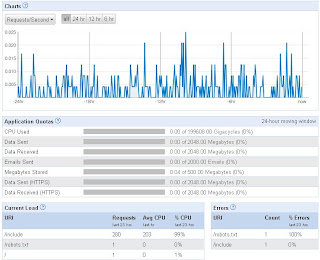 (some stats on a very infrequently used blogquotes app)
This model of utility computing has been something that has been kicked around and toyed with for literally four or five decades. In the beginning it was envisioned that computing would be just like the electrical grid, and you would pay for computing resources in much the same way as you do now. This was back when no one ever believed that a household could use or would need a computer that took up an entire room.
That of course all changed, and we drifted to the current state where everyone has their own (or three). Are we are drifting back to a utility model again with the usefulness of having your data live in the cloud? I know I certainly care less and less about the machine I happen to be using when accessing my data. If the data is in the cloud and therefore accessible anywhere you go, and more importantly from any device you choose (iPhone!) then it naturally just makes sense to perform operations on that data within the cloud as well. Why bring it all down to the client to compute values? Why own multiple computers and have idle processors and half empty disks? (wish I had that problem actually) I think it's a bit early to signal the death knell for the personal computer, far from it, but it certainly gets you thinking.
In terms of energy consumption these are all having significant impact on the overall picture. There still exists an incredible amount of power on the client machine that is largely going untapped with increasingly thin clients (but of course that is reversing now too) and that power is going under utilized when we have servers that are performing the same poorly crafted functions doing the work millions of times over for every page view etc.
There was a blog post in Jan 2007 that talked about how much energy would be saved if google switched from white to black. This post evolved into a full on article on the topic, and a website (Blackle) with a counter for energy saved.
This is all very interesting to me, but to get to my point... Using GAE and looking at very precise measurements of the resources my code and application are using was an incredible moment of perspective for me. Here I am, looking at a direct correlation to the algorithm I choose and a measurable amount of resources being consumed by that decision, amazing really. This is just profiling on the aggregate, but it feels profound. Somehow being in the utility computing frame of mind and looking at my "bill" I am compelled to rethink every aspect of my design to find ways to use less resources. This can only be a good thing. - Sep 3 2008 - From Chrome with Love ...
A million bloggers all posting on the same topic, why shouldn’t I join in. The Google chrome team has got to be enjoying themselves right now. I read the comic yesterday and really enjoyed it. Seeing a company I can’t help but admire sit down and rethink the browser in so thorough of a manner is inspiring. Even just the QA involved is pretty damn impressive.
I’ve been using the chrome browser for a day now and have to same I’m pretty happy with it. I can already feel a need for some of the firefox extensions that I rely on so heavily, but at the same time I feel more productive and less distracted in this browser than I do in firefox. It’s FAST, really fast on my machine at work. I can’t wait until this is available for my mac.
I really enjoyed this article from John Siracusa, it sums up nicely what I find so inspiring about this and points out the real motivation for Google to create yet another browser.
http://arstechnica.com/staff/fatbits.ars/2008/09/02/straight-out-of-compton
(I’m almost regretting my recent commitment to developing an RIA in silverlight! Where oh where are my first class developer tools for browser based development…. ) - Jun 13 2008 - Gadgets in Blogger ...
So I’ve actually started my blogquotes project which was intended as a widget style provider for random quotes (from a personal library) to appear somewhere on my site. I’m using the new Google app engine for this project and so far I have to say it’s pretty damn easy. From barely knowing python to having a django templated, gql driven tiny quote engine. Granted it’s the “hello world” of web apps, but still considering I have an application running on Google, with built-in authentication and datastore …. I’m pretty impressed.
I’ve played with ruby on rails before, but so far I’m far more comfortable with what I’m building here than I ever was with Ruby. (I don’t think I’ll start detailing that here and now as this post is more about my gadget plans and I don’t care)
So I have my application, and I have the beginnings of the backend for my quote providers. I just went to draft.blogger.com where google tests out new features and clicked “add gadget” from the layout view of the blog. I actually thought that what I was looking at was a mistake. 43,000 page elements and gadgets? How is that useful to anyone? How am I not just making the problem worse by adding another one that no one will find and no one but me will use? This is just insane.
I did a search for quote on that page and it returned 13, thankfully none of them are what I have in mind. They are all basically syndication style “[fill in topic] quote of the day” style widgets. There actually seem to be a surprising number of gadgets like that. Things that just don’t really allow the user to add anything meaningful or contextual to the web. I suppose a lot of people use their blogs as their home page, but for me having the weather and a stock ticker on my blog just doesn’t make sense. My Google home page sure, but on millions of public blogs not so much.
There also seems to be too many thinly disguised marketing devices and cheap looking ad-style nothing widgets. Personally I would like to see more of the types of gadgets that Google themselves are creating, where user generated content is the focus (my youtube videos, my picasa albums, my google docs etc) as opposed to content that is one size fits all for millions of blogs. At least it gives me some hope that what I’m doing is not a complete right off.
The data won’t stick, but if you have a google account you can log in and add a quote to the pre-alpha-hello-world-version of blog quotes at http://blogquotes.appspot.com - Jun 10 2008 - Google's changing the rules again (appspot) ...
I am super excited about Google’s recent foray into cloud computing, the app engine. They are not first, I realize Amazon has been doing some pretty cool things with the S3 services and their computing services but the ability to simply and easily have an application that can leverage BigTable and GQL, google account authentication, image manipulation, memcache and having that all live within the seemingly infinite scalability of the google platform is extremely exciting for me. In fact it’s the whole reason for my recent resurgent interest in python. App engine out of the gate is a python runtime environment which is robust enough even to run frameworks like Django for your web apps.
ArsTechnica had some good comments on the service and one of their cheif concerns was being locked into the platform. I think this is not an invalid concern, but that the tools will be written to make migration from one platform to another a relatively trivial matter. From what I understand of GQL it is a subset of normal SQL with limitations like no joins which should make data/code migration easy, but scalability and hosting maybe not so much. There are open source implementations such as HyperTable which is modeled after Google’s data platform, but ultimately the article is right. Personally I don’t see myself writing large scale applications on this platform though, I see this much more as a utility model for small useful services.
I registered for the preview of app engine on the same day it was announced but not early enough to be one of the lucky first 10,000. When I did get my invite a couple weeks ago I immediately started to create applications. It’s clear this is exactly what everyone else did and I’m glad Google has capped usage at three applications per developer. Already it’s almost as bad as trying to register a domain. For each of my three applications I had to try a series of names before getting a clear one. In other words none of my ideas are at all unique. :-) On a positive note when I checked the names I was looking for there were also no uploaded applications for any of them. I predict Google may have to have an expiry date on these - I can see myself taking weeks or months to finally get anything uploaded.
http://silitrader.appspot.com (silverlight port of the old game OilBaron)
http://wherediditallgo.appspot.com (personal spending tracker)
http://blogquotes.appspot.com
I actually created that last application as I was trying to find a simple means of having a rotating list of hand picked quotes show up in the header of my blog. Back when somatose.com was hosted with LunarPages this would have been trivial, throw the quotes into a textfile, write a script to randomly choose and insert one as I was building the page. I moved from a hosted environment to using blogger so that I would stop tinkering and focus on actual content. I spent most of tonight tinkering though, building up to actually building blogquotes. (By the way I am sure there are other blog quote like tools out there, but this is a rare case where I don’t mind reinventing the wheel somewhat)
Now the nature of the tinkering has just changed. Rather than write a small shell script that spits out random lines I will actually build something of a small application/service. The quotes will be stored using the datastore api (GQL), and will be publicly visible. Other users will be able to authenticate and store their quotes in a similar manner. A widget will be built and hosted from that application that enables anyone to paste in a snippet of html to add random quotes from their personal db. I as a user can subscribe to my friend’s quotes. It’s remarkable really, the differences and yet familiarity of this new ecosystem. And while I do miss the control of simply writing a little shell script I have to say I love the idea of the internet being populated by these little widgets of functionality. The emergence of ajax and increasing power on the client means that millions of non-technical users who blog on platforms like blogger and wordpress can very easily use my quote engine. How cool is that?
Google’s API’s (and Amazon’s) are proving to be the next Win32. Massively widespread and base functionality that anyone can build on. The plumbing is there for us to be able to chain together these small tools/widgets in much the same way a clever unix user could within their shell. And once the honeymoon wears off and I actually give some though to hosting data in the US and dealing with popularity should one of my apps get hammered and I end up having to pay Google usage fees… well until all those little issues I can just be excited again about the changing landscape.


