Ajax
- Dec 21 2008 - FlexBuilder 3 First Impressions ...
Where we’re coming from
So at the beginning of the year I was tasked with evaluating a number of technologies for RIA development for the next evolution of my company’s product. Up to this point we had been relying extensively on ASP.NET forms with a traditional post-back model that was responsible for a lot of wasted time and bandwidth. We’ve leveraged a lot of Ajax in the past few years, starting with simple fixes like trees and list based controls that use load on demand and going all the way up to full fledged single page applications that consumed purely services.
This has worked, but the cost is overwhelming for a development team of our size and makeup. We hire smart generalists for the most part, favoring developers with C++/Java/C# backgrounds. Some of our developers have acquired some deeper skills on the client side, but where possible we attempt to leverage control vendors like Telerik and ComponentArt as much as possible. They do an excellent job of hiding some of the complexity involved in cross browser web interfaces, but you will inevitably have to “hit the metal” and get your hands dirty. Relying on third parties also removes a lot of the control needed to do things the way you need them done. Regardless despite being a huge fan of the http://docs.google.com suite of tools, I have witnessed far too much ugliness in our organization with supporting multiple browsers (including having to support IE 6) and pushing the limits of complicated UI in the browser. As the size of the DOM increases and the size of our data sets increase we see wild variance in client performance with respect to things like drag and drop. I know it can be done, I know we are not at the limit yet, but seriously this is not pragmatic for our software and our market and our developers. I am a big fan of the view that JavaScript is becomming the assembly of the web, those who do this shit well, do it well by lifting themselves out of the muck with good abstractions like GWT.
One thing I think should add here in defense of Ajax though; UI design plays a really important role in the effectiveness of the DHTML approach and honestly I believe part of our problem has been designing a far richer interface than we could afford in the technology we were leveraging at the time. Take a close look at Google’s lack of decoration, images etc. These things certainly matter.
Next steps… evaluation
Anyway, I’m getting off topic as usual. In the beginning of 2008 my feature matrix analysis really narrowed our options from about a dozen technologies (including XUL, ActiveX, Applets, JavaFX, Silverlight, ClickOnce, Ajax, Flex) down to three. Silverlight, Flex or Ajax. At the time of my evaluation Flex was at version 2, JavaFX was vapourware and Silverlight2 was in Beta. Given that we are a .NET shop and already have the C# programmers, the Silverlight option was looking like it was going to cleanly win out over Flex. Ajax was honestly only at the table still because we needed to justify our position and show we clearly evaluated all our options. Flex was seen as less desirable due to being based on ECMAScript and having to retool and retrain.
For the most part we’ve seen this as two relatively equivalent technologies with different stories for the developers. While there are important differences between how code is delivered and executed in Flex vs Silverlight, but at a high level we believe technically we can deliver our application in either technology very effectively. We prefer to keep working in C#, but the limited penetration of Silverlight is a serious risk for an application delivered in a SaaS model. That single fact has transformed the whole exercise into largely a business decision. I don’t doubt Microsoft will be able to push their offering significantly, but I would not bet money on where they will be in 1 year. (Windows Media Player STILL doesn’t equal flash in penetration)
Tool support however remains something that is extremely important to developers, and is one of those things Microsoft often trots out in arguing the superiority of their platform. We swallowed that line pretty easily at first, knowing that under the hood all the code written for Flex is just a variation of ECMAScript (JavaScript) is enough to scare us off. How can you acheive the refactorability and tool support provided by current and future versions of Visual Studio with a loosely typed language like ActionScript?
Trying it out
This week I downloaded FlexBuilder3 after one of our senior executives setup a call for us with Adobe evangelists to get more details on why to go with Flex. Again the motivation for this coming back to penetration and wanting to ensure we are making the right decision for what will become a million plus dollar iniitiave to re-engineer. I wanted to get some hands on time with the latest version of FlexBuilder (3) that had come out since our initial research.
I was immediately surprised by the leaps Flex had taken since I last really dived in. I’ll admit there was some bias here though as I am also a huge fan of Eclipse, so the fact that FlexBuilder is built on Eclipse is in my mind a huge win. (not new btw)
The effort in actually building an application that connected to our existing .NET web services was embarrassingly trivial. FlexBuilder has a simple tool for generating and managing proxy classes to represent your web services. So after literally pasting a url into a wizard I had code for talking to our .NET SOAP based web services. (seemed to only support SOAP 1_0 not 1_2) I then got started with the Form Designer and had a simple application talking to our backend in under an hour even counting the little things that tripped me up like where to add my event handlers which wasn’t immediately apparent. (too reliant on double clicking controls apparently ;-) hint : <mx:Script> tags and dom style event callouts)
The concept of states in Flex and the ease with which I was able to create a number of them in the designer and bind those to a dropdown for switching between them was pretty eye opening. A state in Flex is defined by the differences between your main UI (or just another state) and the state you wish to have/be in. The IDE allows you to visually manage these states and then visually modify each one to represent application states. I don’t have an early sense of whether this actually scales for complex applications, but at first glance it’s very cool. (Think hierarchical state machine) Couple this with the data binding model and you have some very effective UI management tools at your disposal. Maybe this only looks cool coming from our antiquated asp.net approaches, but this stuff is exciting. (Silverlight/WPF have the same capability, maybe even a little more advanced but with more overhead in my opinion) Having your model drive all changes is so much more manageable, scalable… and just correct than having explicit assignments in page PreRender methods that set visibility based on the state of that model. Barf.
The control toolkit out of the box with Flex is also extremely impressive. Check out this post for a list of all the FlexBuilder 3 Controls included out of the box . For now at least this control set will mean being highly more productive in the early stages of development than if we were either having to roll our own or rely on third party vendors. And of course you can roll your own in both Silverlight and Flex and each can be just about anything imaginable.
So I’m sold, at least sold on the fact that Flex deserves considerably more attention than what we had previously given it. I’ve bought the “Flex 3 Cookbook”, and “Adobe Flex 3 Training From the Source” and I’m intending on spending at least some of this Christmas holiday catching up on just what’s possible with that silly little flash technology. - Dec 12 2008 - ajax for mac lovers ... Another Ajax Framework : (or rather, an Application Framework)
http://cappuccino.org/
http://cappuccino.org/learn/
Demo app built using it:
http://280slides.com/
And a teaser for all those interface builder lovers out there :I came across this in reader this morning and was totally blown away by how well the 280 slides application worked. It's really impressive... on non IE browsers. I sent the link to a co-worker to check out and he basically dismissed it as too slow and unresponsive, "typical web app". It took a minute or two to realize the browser was the problem at which point I launched the app in IE 8 Beta (IE 8!) and it performed terribly.It looked terrible, it was jerky and generally just a big let down after the speed of Chrome.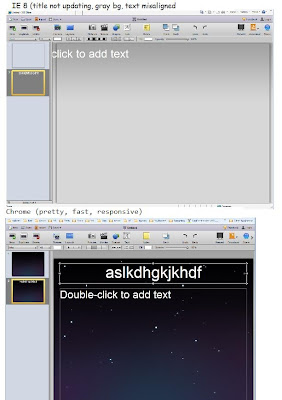
Whatever the technical reasons are, it sucks. Let's hope the new generation of javascript engines (FF3.1 and Chrome) are able to push Microsoft into stepping up. I'm excited about Flex and Silverlight and JavaFX but really I want to believe we can keep pushing the browser without the plugin. - May 11 2008 - ASP.NET Ajax Pendulum ...
I’m currently working on moving a web application from using some ad-hoc javascript and iframes to a full fledged ASP.NET Ajax implementation based around Telerik’s RadControls and a suite of our own controls. This is the third application we’ve given the ajax treatment to and each time we’ve taken a slightly different approach.
Approach 1 … “Javascript + Web Services”- Full view manager/page controller implementation on the client side to handle events thrown by all the components on the page
- Homegrown “ServiceManager” to handle brokering calls to the server
- Centralized error handling
- Shared message contract base class to allow “sub-messaging” for the server to send information to the view controller on the client
- Blocking calls when things needed to be “modal” or serialized
- … we had intentions of also building in grouping of calls
- … we had intentions of canceling redundant calls when the user was asking for something that made a previous call unnecessary
- Centralized error handling
- Chatty - many calls, small amounts of data (largely json)
- Javascript controls that render almost strictly client side based on data delivered over web services
- Zero postbacks / Very fast
- Expensive/Complex development and maintenance
- Prone to memory leaks
- More difficult to leverage third party controls
Approach 2 … “Update Panels”- Traditional ASP.NET development with a sprinkling of update panels where it made sense
- Chunky communication… partial postbacks, but still heavy
- “Simple” development - UpdatePanels were spotty at the time, there were quite a few workarounds hacked in to this interface
- Medium reliance on third party controls
- Less performance than “Javascript + Webservices”
- Less transparency and control to developers
Approach 3 … “Javascript + Web Services + Update Panels”- A view controller/ page manager approach similar to Approach 1 except that in this iteration we are relying on the ScriptManager and it’s events to handle a lot of what we were previously rolling on our own.
- A heavy usage of Telerik’s Prometheus suite of controls, which in turn is built against the Microsoft Ajax Framework
- Webservice layer for a class of managed actions where we control the control flow via our view controller
- Partial updates for more complex control interactions/workflows
- These are sometimes triggered by the controls themselves in which case we are dealing with “chunky” transactions
- Othertimes triggered by the page manager in which case we have small requests and potentially heavy responses
- Good use of third party controls
- Chunky or Chatty based on need
- Medium development complexity
- Less transparency/control for developers
- High development complexity
- Better performance than Approach 2) but less than 1)
- Still prone to memory leaks
So you can see across these three different applications we’re dealing with a swinging pendulum of ajax development methodologies and philosophies. My hope with our most recent approach was that we would have the strength of increased reliance on Microsoft’s framework + Telerik’s suite of controls combined with hooks and web services to eek out that extra level of performance whenever needed.Of course in this latest iteration we also have the added complexity of having to port legacy controls on a very difficult timeline. So we have a collection of editors, some of which are doing chunky partial post-backs whereas some of our newer type editors are using a more… let’s say finely tuned approach where only the necessary data is sent and only limited page updates are performed.The third option still has some proving out to do. Rather then being the perfect blend of complexity vs performance vs reuse vs transparency is instead turning out to be not especially good at any of these. I’m frankly a bit frustrated by the whole exercise right now an am increasingly eyeing the glorious promises of Silverlight.Really I don’t see this stuff getting any easier until we’re either seeing browsers that have equivalent capabilities in supporting Html 5 and all the exciting new javascript features of the future or a widespread installed base of Silverlight 2. haha… right.